Not if I can help it is the short answer!
In essence, the title strikes to the very heart of my reason for writing my book Penny Practically Does…Renovation. Headlines pop up in the press all too often featuring unfortunate situations that have arisen during a property renovation with the house owner left in a mess and sometimes in financial difficulty as a result. During my renovation career I have been called into renovation disasters and brought them to a successful conclusion. These have not been limited to residential properties – problems can occur in commercial circumstances too.
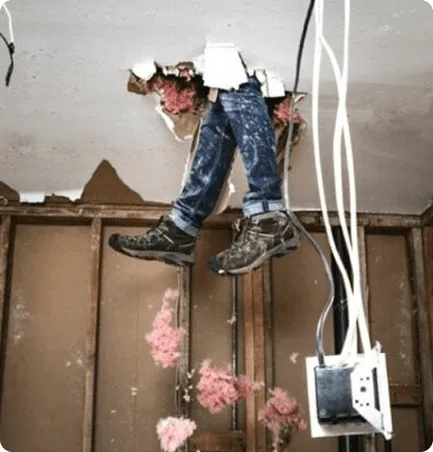
Often it is unscrupulous contractors that get the blame and indeed it is true to say there are some bad apples in the barrel of the construction industry. However that said, there are usually two sides to every story and I’m afraid in my usual direct fashion I am going to say it how it is… heartbreaking though these situations can be, the householder must also take some degree of responsibility. Whilst inexperience can be a mitigating factor, no one even thinking of making improvements to their property can rely on the adage that “ignorance is bliss”. In my experience it rarely is, and adequate research, understanding of the property and any proposed works, is key to a successful outcome.
We have all seen the renovation programmes that proliferate our TV screens…they make us think more critically of our living situation and whether we can do something to enhance our own property. In the main, these programmes provide a good source of inspiration and in some cases useful information. One thing to remember though is that behind the screen and the presenters are an extensive team of researchers with access to the very best help and advice on offer. We tend to see the edited presentation, which can give the impression that the process of renovating a property is easier than it might be in the reality of off-screen life.
Let me give you a cautionary tale…it is a true story and I’m not naming any names…
A professional couple bought a house and decided to extend it to gain additional living space – a new, bigger kitchen on the ground floor and the addition of a master bedroom and ensuite on the first floor, in addition to other works within the property. A main contractor with a multi-disciplinary team including a project manager was selected after several quotes. Work commenced with a projected timescale of six months. Whilst initial progress seemed to be made, it became obvious that work ultimately stalled at the point the exterior works were virtually complete, which had taken 12 months. None of the interior works had been done – it was the equivalent of a building site, and the householder had continued to live in the property for the duration. The contractors made repeated requests for money, which were granted by the householder believing it would speed up progress. Long story short, additional money had to be injected into the project to get it back up and running.
Eventually the new kitchen area was plastered, the kitchen units installed, the tiling completed. It seemed there was light at the end of the tunnel, until…
…it came to what should have been the 2nd fix for the electrician and the plumber i.e. the final connections. At that point the project manager realised that none of the infrastructure had been installed – no electric cable for lighting, sockets or appliances, no pipework for the hot and cold water, and no waste pipes to take away the wastewater. And, all the walls had been boarded, plaster skimmed and tiled…not a great scenario!
Suffice to say, all the work had to be repeated at significant additional cost to the householder who was perhaps in the fortunate position of being able to pay for it. It transpired later there had been no contract of any substance between the two parties, no agreed milestones, an inexperienced and very young project manager, the main contractor had given the householder little idea as to how the work was supposed to progress, and they in turn had assumed, incorrectly as it turned out, the contractors they had employed were competent to do the job. Happily, their project was finally completed…after a total of two years (18 months overrun on the original estimate), considerable inconvenience, and well in excess of the original budget.
When I asked if they were to undertake the project again what would they change, the householder readily admitted they had lacked some of the most basic knowledge about their property, coupled with a little understanding of what was actually involved in the renovation they were about to undertake and how it was supposed to be managed – from the financial as well as the work perspectives. They didn’t know what the contractors should have expected of them, and they hadn’t asked the right questions to determine that they had the right contractors… because they hadn’t known the essential questions to ask. All in all, a vicious circle.
A house for most people is their single biggest asset. Money is hard-earned. Most work to a property, completed in the right way, is investing proactively in that asset. It is not an unreasonable expectation that a return on investment by way of a profit can be achieved, when you sell. Depending on the scale of a project, renovation works can be expensive – no one wants to be in the position of losing money or, at best, putting in a lot of hard work and finding that once all costs have been taken into consideration you have simply broken even – neither losing nor making any extra money.
I have often been asked what advice I would give anyone intending to undertake a property renovation. Whilst there are many factors to take into consideration, which I go into in more detail in the book, here are several that hit the top of my list:
- Fully understand the property in its entirety and your forthcoming project in intricate detail – you are less likely to believe any nonsense fed by an unscrupulous contractor.
- Ensure you have the requisite permissions from all the relevant authorities before the commencement of any works.
- Never underestimate the importance of adequate planning of your project, prior to the commencement of the actual work. That’s how mistakes occur and they are usually expensive to rectify. In my experience, the pre-works planning process can take as long, if not longer than the actual works, depending on the scale of the project.
- Always manage and execute your works in the correct order – this will help to keep your project on track and within estimated timescales.
- Manage the money and keep your budget on track – don’t be tempted to change your mind mid works – it will cost you additional pennies and potentially extend your timescale.
- Nothing in my experience is insurmountable. Communication is key and never be afraid to ask questions of anyone. You are not being a nuisance, knowledge is everything!
Has everything always gone right for me on every job I have undertaken on behalf of my clients…? Absolutely not, because the unexpected does happen – that’s called Life! The difference is that additional to the investigation and pre-planning that goes into each individual project, I actively project manage on-site any job I am involved with. That involves dealing with all aspects of site safety, contractors and material deliveries, to name but a few processes. Problems must be acknowledged and dealt with quickly as they arise and not left for an unwary householder to discover later.
To my mind, prevention is better than cure, hence my book. I wrote it specifically for all of you thinking about renovating your own property. I don’t want you to be in a similar scenario as the couple whose project I described above. I want you to be able to approach your projects in a practical way, empowered with knowledge and confident of the path ahead. Although useful at any stage of your project, the ideal time to read the book is before you start and then you can think clearly about your project from A to Z. It was important to me to write a book that was practical, understandable and useful so that my readers could take the information and easily apply it to their own renovation projects, whatever the size.
When I bought my first house, which needed top to bottom renovation, my knowledge was a big fat zero, but I was enthusiastic, believed it was possible (somehow!), and willing to learn. I acknowledge I was lucky finding the right contractor! I turned what became a passion for breathing new life into property into a business, project managing substantial renovation projects for both commercial and residential clients. I have always been committed to learning new skills and despite more than 25 years of experience, I never stop asking questions of anyone.
Building Regulations for example, which apply to anyone undertaking a renovation, change faster than the weather sometimes…ensuring compliance is important, householders included, as dodging the rules can adversely impact your property.
If you have a particular topic you would like me to talk about then please either email me or contact me via the website. And of course when you have completed your projects, I would love to see your results too, which you can post on the website.
It’s my belief: “If I Can Do It, You Can Do it!” With the right information at your fingertips, I am confident you can.